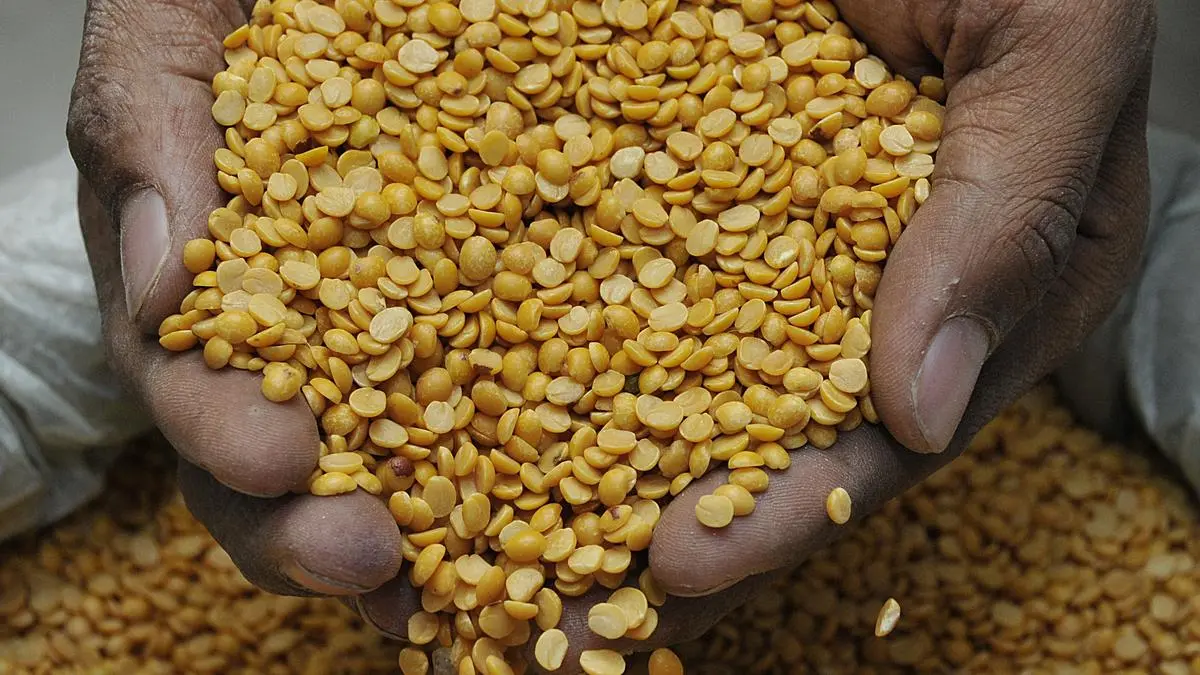
Pigeonpea (tur dal)
| Photo Credit:
SIVAKUMAR PV
In a landmark innovation that could help solve India’s scarcity in pulses, scientists at the International Crops Research Institute for Semi Arid Tropics (ICRISAT) have developed a pigeonpea (tur dal) variety that could withstand extremely high temperatures (up to 45° C). This trait could turn about 12 million hectares of rice fallows (which grow paddy in kharif but largely left idle in rabi due to high temperatures and nonavailability of enough water to grow a crop).
The innovation would also help farmers in Africa and other parts of the world where pigeonpea is in short supply.
ICRISAT scientists deployed a technique called speed breeding to cut short the breeding time significantly. The protocol helped researchers grow up to four generations a year, reducing the time required to develop a new variety from 15 years to just five.
India currently produces 3.5 million tonnes of pigeonpea annually, falling short of the 1.5 million tonnes needed to meet domestic demand. This results in $800 million worth of imports every year.
Besides withstanding high temperatures through the 40 days of the flowering stage, the new variety – ICPV 25444 – will help farmers double the output to 2 tonnes a hectare from the current level of 1.1-12 a hectare, Himanshu Pathak, Director-General of ICRISAT, has said.
“It reduces the barrier for pigeonpea from being grown in the summer season across several parts of the country. This challenge deters farmers from growing pigeon pea in the summer season. The new variety would require very little water. There are several other benefits. It reduces the time-to-harvest period to 4 months from the present period of 6-7 months,” he said.
Besides, the crop is grown at a uniform height, unlike the traditional varieties, which see the plants at different heights, making it difficult for machine harvesting. “This heat-tolerant, photo- and thermo-insensitive cultivar has been successfully tested in Karnataka, Odisha and Telangana,” he said.
“By transforming pigeonpea into an all-season crop, our scientists have come up with a solution that has the potential to address pulse shortages and climate challenges faced by farmers across India,” he said, demonstrating the crop on the institute’s Patancheru farm to a group of journalists here on Monday.
Speed breeding
Prakash Gangashetty, Senior Scientist – Pigeonpea Breeding at ICRISAT, said that the protocol, developed over a year, tackled the complex problem of speeding up the generations of crop improvement and reducing the time it took for the advanced cultivar to be submitted for registration trials to 3-4 years.
Published on June 9, 2025