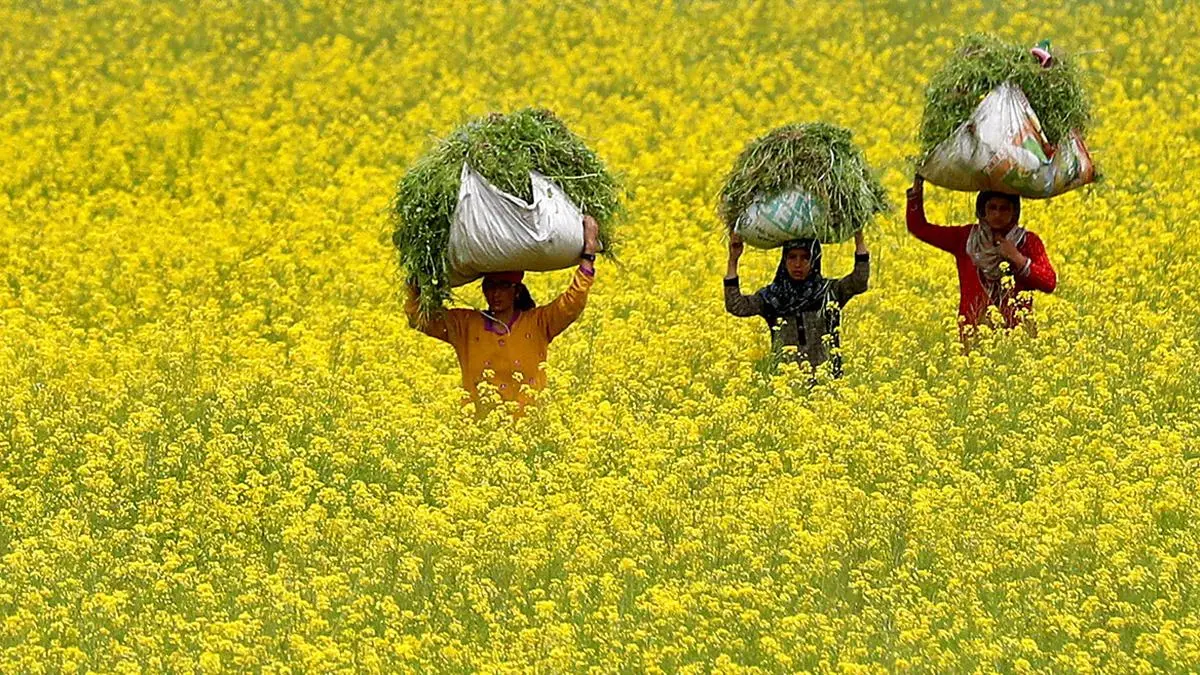
A group of farmers in Rajasthan has decided not to sell mustard below ₹6,000/quintal at least until March 15 and will decide their next course of action after analysing the consequences. Currently mustard prices are ruling below its Minimum Support Price (MSP) of ₹5,950/quintal.
“We have decided not to sell mustard below ₹6,000 and will spread the message to all the growers of the crop in key districts as Rajasthan has 50 per cent share in the area of the rabi season’s main oilseed crop,” said Rampal Jat, president of Kisan Mahapanchayat.
He said many mustard farmers in Tonk, undivided Alwar districts had taken vows on Mahashivratri and are not likely to violate it by selling below that price. “We have been continuing our sarson (mustard) satyagrah for quite some years to ensure that farmers get at least the MSP as the government has not yet accepted the demand for legal guarantee,” Jat told business line.
Rajasthan crop estimate
The State government has estimated mustard production at 55.57 lakh tonnes (lt) for current crop whereas the Centre is yet to release its estimate. The State government has said that mustard production in Tonk is estimated to be 5.51 lt, in Ganganagar 4.85 lt, Hanumangarh 3.79 lt, Sawaimadhopur 3.03 lt, Alwar 2.88 lt, Bikaner 2.69 lt and Bharatpur 2.37 lt.
There was a drop in overall area of mustard this year which experts attributed to continued rainfall till end of October. India had 132.6 lt of mustard production in 2023-24 in which Rajasthan had 57.58 lt contribution, which is 43 per cent share.
Jat also demanded that the Centre should remove roadblocks like cap of 25 quintals from a farmer in a day and the official procurement window of 90 days to help improve prices. “The actual purchase period does not even remain 70 days citing unjustified reasons like shortage of gunny bags, strike of employees. Though mustard starts arriving from mid-February, the procurement starts only from April,” he explained.
Adulteration’s role
The prices of mustard drop due to adulteration of cheaper items like palm oil and reducing the import duty to the minimum, he said. Till 1984, the country was self-sufficient in edible oil, due to which there was no need to import oil. After that, due to the policy, the import duty of 85 per cent was gradually reduced to zero, Jat said.
“This started the increase in oil import and due to the liberalisation policy of the year 1991, imports got increased. In this direction, provision was made to relax the law, allowing adulteration by introducing a new name called ‘blending’ in edible oil. Though in case of mustard oil, this provision was withdrawn in 2020, but due to no meaningful effort to prevent adulteration, pure mustard oil is still not available to the people,” he said.
As mustard producers were deprived of fair prices, the Kisan Mahapanchayat in 2023 had organised a mustard ‘satyagraha’ by observing a fast in New Delhi, he said and added that several memorandums have been submitted since then, without any fruitful result.