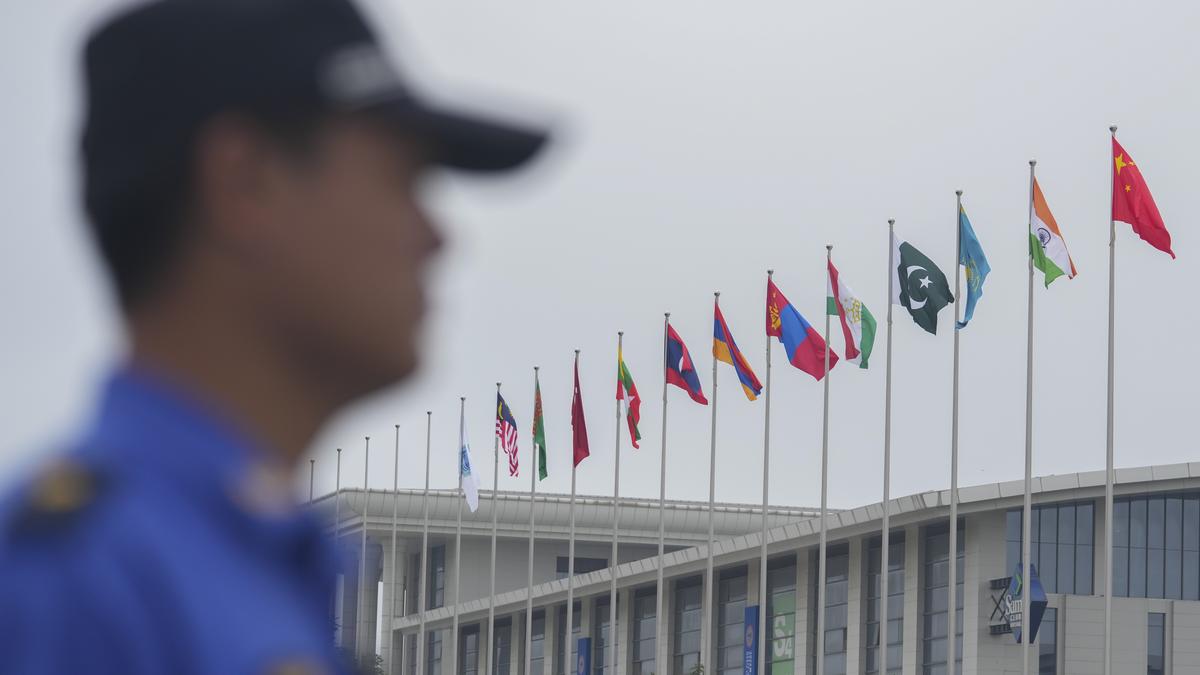
A security guard stands near the flags of Shanghai Cooperation Organization (SCO) member states outside the venue in Tianjin, China , Saturday, Aug. 30, 2025. (AP Photo/ Rafiq Maqbool)
| Photo Credit:
RAFIQ MAQBOOL
In the face of US unilateralism and tariff onslaught, India has pushed for leveraging the strength of the SCO countries, including China, Russia and Pakistan, for a development-centred WTO agenda. The move is aimed at a permanent solution on public stockholding (PSH) for food security among other measures for developing countries at the multilateral body.
Experts say this positioning could be crucial at this moment as the WTO is preparing for its 14th Ministerial Conference in March 2026 in the midst of countries grappling with US’ unilateral actions.
Trade imbalances
At the SCO Trade Ministers’ meeting in Vladivostok on Saturday, New Delhi also alluded to its rising trade deficit with Russia and China and noted that persistent trade imbalances must be addressed through better market access, cooperation on standards, and streamlined trade facilitation.
“India cautioned that export-related measures should not be weaponised or misused to create artificial scarcity, distort markets, or disrupt supply chains…,” per a government statement.
A development-centred WTO agenda must also include effective special & differential treatment (S&DT) for developing countries and freer movement of workers, New Delhi’s representative noted at the SCO meet.
“India’s positioning will provide a much-needed common platform not only for the current SCO members, but for other developing countries and LDCs which have common interests to secure a permanent solution on PSH and a working dispute settlement system that can reign in the rampant abuse of the WTO system,” said Ranja Sengupta from Third World Network.
It can help steer the WTO towards more development-oriented outcomes and challenge the pressures from the US, Sengupta added.
Coordinated action
The ten-member SCO also includes Kazakhstan, Kyrgyzstan, Tajikistan, Uzbekistan, Iran and Belarus. “With the SCO accounting for 42 per cent of the world’s population and 17.2 per cent of global trade, India emphasised the importance of coordinated action to enhance trade flows, address vulnerabilities,and support inclusive growth across the region,” the statement noted.
The US has been opposed to India and other developing countries demand for a permanent solution to PSH at the WTO that would allow them to expand their MSP and food security programmes without worrying about breaching subsidy limits. It is also not keen on changes that would make S&DT provisions, that bestow special rights and lower reciprocity on developing countries, become more precise and effective.
“India’s position at SCO will lend political heft to India’s interests at the WTO, many of which are also shared by a large number of other developing countries,” said trade expert Abhijit Das.
Published on September 7, 2025