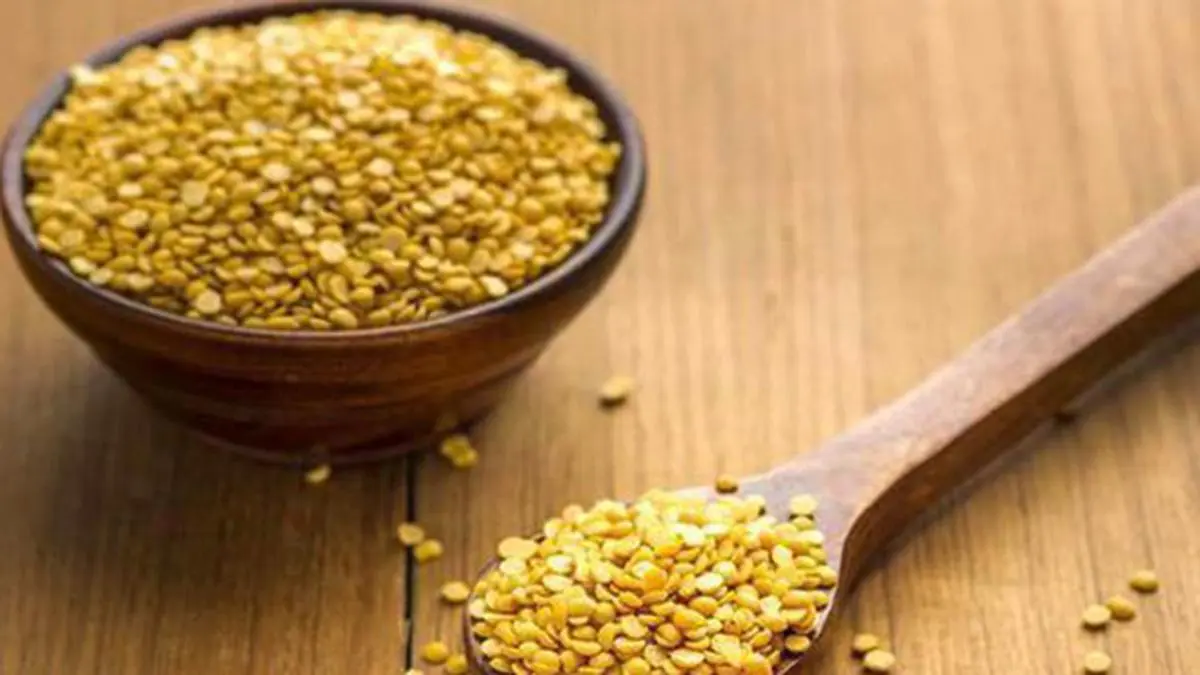
toor dal or arhar dal or raw pulses in wooden spoon and bowl
| Photo Credit:
Prabhjit Singh Kalsi
A Niti Aayog’s report on pulses, released Thursday, has said that a systems approach incorporating crop-specific and region-specific cluster strategies is essential to increase the area and production of pulse crops.
However, some experts said that the report could have included specific action plans not only in pulses, but other competing crops as well since farmers always select the best suitable both economically as well as long-term sustainability.
Authored by Neelam Patel, a senior adviser at Niti Aayog, and six other young professionals, the report — Strategies and Pathways for Accelerating Growth in Pulses towards the Goal of Atmanirbharta — the report has recommended crop-wise clustering facilitates both horizontal and vertical expansion efforts for targeted growth in pulse production.
“States and districts are grouped into four clusters (HA-HY, HA#LY, LA-HY, and LA-LY) based on the area under cultivation and yield performance for each pulse crop, allowing for more tailored growth strategies. Developing customized technology specific to each cluster is essential for yield improvement. Additionally, establishing Agro-Ecological Sub Region (AESR)-based model farms for each crop can support the horizontal dissemination of advanced cultivation practices.
“Utilizing just one-third of the total rice fallow area across ten states for pulse cultivation has the potential to enhance domestic production significantly. Estimates suggest a potential increase of up to 2.85 million tonnes (mt) in pulse output. This statistic underscores the immense potential of these currently fallow lands. A combination of incentives and strategic planning is necessary to effectively tap into this potential. Providing incentive packages for input costs and guaranteeing remunerative prices can motivate farmers to adopt pulse cultivation in these areas.
“Identifying suitable areas for pulse cultivation, with the involvement of experts and states is crucial. A phased approach, starting with pilot projects in key states, can help refine strategies and maximize impact.”
As seen in this year’s sowing pattern, farmers’ preference for paddy and maize is higher than any other crop and the areas under these crops is around 10 per cent higher. The initial gain due to an early start of planting of moong (green gram), compared to year-ago, led to some false impression which got dissipated with time and the acreage under it is 15,000 hectares higher than year-ago.
“Unless the government chalks out holistic crop policy, no secluded policy will have success guarantee. For both maize and tur, the government launched scheme of assured purchase at MSP through Nafed. But farmers have expanded area under maize by 12 per cent and lowered tur coverage by 2 per cent this year,” said a former senior official of the agriculture ministry. He said earning the trust of farmers on assured price, through private trade is more effective.
The report said that the period after 2004 witnessed a marked acceleration in India’s pulse production, largely influenced by targeted government schemes. The National Food Security Mission (NFSM) – Pulses, initiated in 2007, propelled the growth trajectory by emphasizing area expansion, productivity enhancement, and modern technologies. The mission-mode approach ensured that interventions were effectively implemented and resources reached the intended beneficiaries.
The authors have also suggested compulsory inclusion of pulses in the existing schemes, such as the mid-day meal scheme or public distribution system (PDS) to ensure minimum pulse consumption by poor households is maintained even during the scarcity in pulse production. “Keeping in view the widespread under- and malnutrition among women and children in India, to achieve the target of zero hunger and good health and well-being prescribed in sustainable development goals (SDG), it is necessary to provide pulses to all the poor households at affordable prices,” it said.
Although this would further increase the demand for pulses, it can be managed if sufficient steps for enhancing domestic production are already taken, it added.
Published on September 4, 2025